

ITINERARY 4
Sulle orme di Federico II
Our journey among the traces of faith and natural paradises led us to Castroregio, the beautiful village located in the inland area of the Alto Ionio region. From here begins a new adventure to discover the territory of the Sibaritide aLAG. The leitmotif of this itinerary lies in the monumental signs left by the Suevian domination, in particular the majestic castles, many of which date back to the time of Frederick II, the great emperor who, in the first half of the 13th century, was the protagonist of an extraordinary era of social and cultural rebirth in Europe and who left indelible traces of his presence here.
Map
Specifiche tecniche del percorso
5
Locations
35
Travel distance
9
Points of interest
ITINERARY 4
Description of the itinerary and stages
The stages
Amendolara: land of history and myth

We set out from Castroregio to head towards the coast along the scenic route of the SP 155 provincial highway, which runs along the ridge between the Straface and the Ferro torrents. Shortly after the junction with the SP 266 provincial highway, a small road branches off to the right. It is a small deviation from the main route of the journey, but it is well worth taking because it leads us to the Bosco di Straface (Straface Wood), a magnificent green area ideal for picnics and excursions in the shade of pine trees and ancient oaks. Here is the church of Madonna delle Grazie (Our Lady of Graces), the starting point, on the first Sunday of September, of the traditional procession that winds its way through the forest paths.
Back on the SP 266 provincial highway, we continue in the direction of the coast until we come in sight of the historic centre of Amendolara, which we see on the top of a hill. The best way to visit this town is to leave the car in Piazza Giovanni XXIII and walk through the streets of the centre. An interesting sight is the church of Santa Maria (Saint Mary) in the old quarter, dating back to the 9th or 10th century. In the historic centre there is also the Romanesque Mother Church, dedicated to Santa Margherita (Saint Margaret) and, not far away, the Frederician Castle, originally built between the 8th and 9th centuries on the ruins of a Longobard stronghold. Restored by Frederick II of Swabia, the castle became his most important residence between Calabria and Apulia. Not to be missed is a visit to the “Vincenzo Laviola” National Archaeological Museum, which houses earthenware vases, weapons, jewellery, grave goods, ceramics, metal artefacts and thousands of clay weights, many of which come from the nearby excavations on the San Nicola plateau, the site of one of the first human settlements in the area, preceding even the foundation of the Greek colonies linked to the Polis of Sybaris, as well as the site of the archaic city with the Paladino Mancosa necropolis, which will soon become an Archaeological Park. The Museum of Protohistory will also be inaugurated shortly.
Important are also the testimonies of the Byzantine era, including the already mentioned church of Santa Maria, the church of San Giovanni Armeno (Saint John of Armenia) and the church of the Annunziata (Annunciation).
Equally important are the monuments from the Roman period, including the remains of the Statio ad Vicesimun of the Antonine Itinerary, as well as those of the Roman Tank, Baths and Necropolis.

Amendolara is also the birthplace of Pomponio Leto, of the House of the Sanseverino princes, humanist, founder of the Accademia Romana (Roman Academy), whose birthplace is known and to whom a square, a street and a school in the town are dedicated.
Amendolara, however, is not only ancient history. Interesting sights for contemporary art enthusiasts can be found here. In fact, the village is the birthplace of Antonio Sassone, an acclaimed Italo-Argentine painter, sculptor and poet, whose works are displayed in the Council Chamber of the Town Hall, as well as in the Mother Church and in the Municipal Auditorium. Also designed by Sassone is the small church of Santa Lucia (Saint Lucy).
Amendolara was once famous for the production of almonds (from which it takes its name), which are still the basis for the preparation of the local amaretti biscuits. Among the must-tries of the local cuisine are the handmade “raschiatilli”, seasoned with tomato and basil, the “ferrazzuoli” with meat sauce, and the delicious “crispi”, rings of wheat flour, fried in extra virgin olive oil and sprinkled with sugar to taste. Other traditional dishes are cuttlefish with peas, the “licurda” soup, “tagliarilli” with chickpeas, and tagliatelle with salt cod and toasted breadcrumbs.
After this culinary interlude, it is time to get back on the road. Still along the SP 266 provincial highway, we head towards the coast passing by the aforementioned Byzantine church of the Annunziata, also known as the Cappella dei Greci (Chapel of the Greeks). Situated on a small rise dominating the coast with splendid panoramic views, the Chapel, with a typically Byzantine plan and dome dating back to the 9th-10th century, is flanked by numerous caves and, for this reason, is believed to be the cornerstone of an ancient hermit centre.
Arriving on the coast, we cross northwards through the town of Marina di Amendolara, a popular seaside tourism centre, famous for its beautiful beaches located right in front of a large shoal, the Secca, about 12 miles from the coast. Due to the variety of marine species that colonise it, the Secca is a veritable paradise for diving enthusiasts, but it is also a place linked to history and mythology.
Here, according to tradition, once stood the mythical Island of Ogygia where Ulysses stayed for seven years as a not exactly “reluctant” prisoner of the nymph Calypso before returning to Ithaca. The area has now become a Regional Marine Park. Continuing along the coast in the direction of Roseto, it is possible to admire the entire Sibaritide gulf, guarded by the massive architecture of the Torre Spaccata (Cracked Tower), one of the many fortified posts erected to guard against the raids of Saracen pirates.
Roseto Capo Spulico: roses and castles…
Once past the wide mouth of the Ferro torrent, from where, looking to the west, we can see the Pollino heights, we reach Marina di Roseto Capo Spulico. We could cross the centre of this tourist destination by continuing straight along the SS 106 highway but, for those who are not in a hurry and want to fully enjoy the beauty of this area, the advice, having reached the first houses, is to turn right into Via Olimpia, heading towards the coast: here we are in front of the famous Lungomare degli Achei (Achaean Promenade), a magnificent promenade overlooking some of the most beautiful beaches on the Ionian coast and its splendid Blue Flag sea.
Driving up the road, a majestic building catches our attention: it is the Castrum Petrae Roseti, one of the symbols of this area which, perched on a rock, dominates the beach with its towers soaring above the waters of the Ionian Sea. The manor, now a private property and home to an elegant restaurant, was for centuries a fearsome warning to those who dared to land on the coast. Built in the 11th century and then passed into the hands of the powerful order of the Templar Knights, it was requisitioned from them by Frederick II as punishment for their betrayal during the 4th Crusade. According to tradition, it was here that the Holy Shroud was kept during the reign of the great emperor. In this place pervaded with mystery, Frederick II of Swabia left important signs of his passage, as evidenced by the discovery of an Onfale, a stone sphere engraved with the signs of the Passion of Christ, as well as numerous stone signs enclosed within the walls of the manor. Discovering them all is an esoteric journey through the traces of the ancient secrets of the Stupor Mundi.
Not far from the manor house another rocky profile rises above the shoreline. This is the Scoglio a Incudine (Anvil Rock), a curious and characteristic natural formation that has also become an iconic image of the Alto Ionio Cosentino region.
Although the beauty of Marina attracts the attention of most tourists, the most ancient heart of Roseto Capo Spulico beats in the immediate inland area. It is here, in fact, that lies the village around which, according to local legends, roses bloomed, whose petals were used to stuff the pillows of the richest inhabitants of the Greek colony of Sibari. In fact, the history of Roseto Capo Spulico is intertwined with the myth of Ancient Sybaris, one of the wealthiest and most important cities of the Magna Graecia, of which Civitas Rosarum was one of the twenty-five colonies.

Having quickly reached the historic centre, you cross Porta della Terra (Earth Gate), the city gate giving access to the oldest inhabited nucleus, from which the old city walls unravel, to penetrate on foot into the maze of narrow streets, alleys, squares and breathtaking views that characterise the Borgo Autentico (authentic village) of Roseto Capo Spulico. And it is precisely by getting lost in these alleys that you can walk along the famous Strettella, one of the narrowest alleys in Europe, closed between two walls no more than 50 centimetres apart. This narrow street is also known as Vico or Vinella degli Innamorati (Lovers’ Alley), an extremely characteristic place where so many lovers of the past used to meet for that stolen kiss, for that much-desired and long-awaited meeting of glances, for that authentic promise of love. Kissing in the centre of the Vinella meant – and means, as tradition has it – a good wish for eternal love and a long and happy union…
The village of Roseto has its castle too, the Castrum Roseti, built in Norman times at the behest of Robert Guiscard. A self-sufficient fortress, equipped with stables, prisons and self-defence systems, which today, completely restored, houses the municipal headquarters. In the atrium of the Castrum Roseti is the Ethnographic Museum of Roseto Capo Spulico, dedicated to the memory of its founder Leonardo Salomone, which houses more than 2,000 objects, evidence of the ancient trades, traditions and daily life of the local population. Another small jewel not to be missed is the beautiful Chapel of the Immaculate Conception, better known as “Santo Totaro”, the name given to the sarcophagus placed on the church façade. Inside, the chapel contains paintings and frescoes of considerable value and many mysteries and stories yet to be discovered.
Montegiordano: a friendly village

Leaving the historic centre of Roseto, we return to the SS 106 highway, continuing our journey along the magnificent coastline until we reach Marina di Montegiordano. Again, we head inland, following via del Carmine, which climbs among gentle undulations towards Piano delle Rose. Just beyond a bend, amidst the green Mediterranean scrub and majestic olive trees, the massive silhouette of the Montegiordano Castle appears. Its presence is documented as early as around 1452, when there was an inhabited and walled feud here. After a period of abandonment, starting in 1656, at the behest of Marquis Aurelio Leone, the manor was restored as a winter residence used for hunting and fishing. In 1763, the renovation of the structure was completed. Between 1879 and 1881, the castle and the adjoining properties were auctioned off and purchased by the Solano family.

Past the manor house, we join the SP 148 provincial highway. Even just driving along these roads is an immense pleasure: all around is a green and well-tended countryside, where the view seems to run without limits. Here we are, finally, at the houses of the village of Montegiordano.
This small town of agricultural traditions has no great monuments to offer visitors, but among its dwellings decorated by the lively murals of the local artist Franco Lateana, the visitor can breathe an air of familiar simplicity and hospitality, enough to feel pleasantly at home.
Walking through the alleyways, we come across evidence of the fervent local religiosity, eloquent symbols of the devotion around which the town’s community cohesion is built. These include the Croce del Secolo (the Cross of the Century), erected on the occasion of the 1900 Jubilee proclaimed by Pope Leo XIII, and the Calvary with five crosses, evoking the five stations of Christ’s Passion.
Outside the built-up area, in the locality of Caprara, the ruins of the Grancia and of the Chapel of Saint Michael the Archangel take us back through the centuries to the time of Frederick II of Swabia, who granted the Cistercian monks ownership of the large territory, then covered by luxuriant forests, where an abbey arose that was prosperous and powerful for a long time.
Oriolo, an open-air museum

Leaving the village of Roseto, on the left we find the SS 481 highway that seems to continue endlessly through hills, woods and meadows. The asphalt ribbon winds along the wide and scenic ridge, skirting the Ferro torrent. Suddenly Oriolo appears, perched on a sandstone cliff, protected by imposing bastions and gathered around the bulk of the ancient castle. This is a village of remote origins. The signs of human presence in the area date back to the time of the Magna Graecia colonies, but it was during the Middle Ages that its sheltered and strategic position made it a landing place for populations fleeing the Saracen invasions on the coast. The great castle, with its circular towers, was for centuries the heart of a true fortified citadel, built to withstand the fiercest sieges and so powerful that it survived even natural disasters such as the terrible earthquake of 1693.
Today, Oriolo is a small pearl of history and culture included in exclusive clubs such as the Borghi più Belli d’Italia (Italy’s Most Beautiful Villages) and the Borghi bandiera Arancione (Orange Flag Villages) clubs of the Touring Club Italiano. The municipal administration has enhanced the town as a real open-air museum. The entire hamlet, in fact, constitutes the MUDAM – Museo Diffuso delle Arti e dei Mestieri (Widespread Museum of Arts and Crafts), offering an ideal tour starting from the castle, the symbol of the town and a centre equipped to host concerts, exhibitions and conferences, where it is possible to admire valuable frescoes and an interesting display dedicated to medieval and Renaissance clothing.
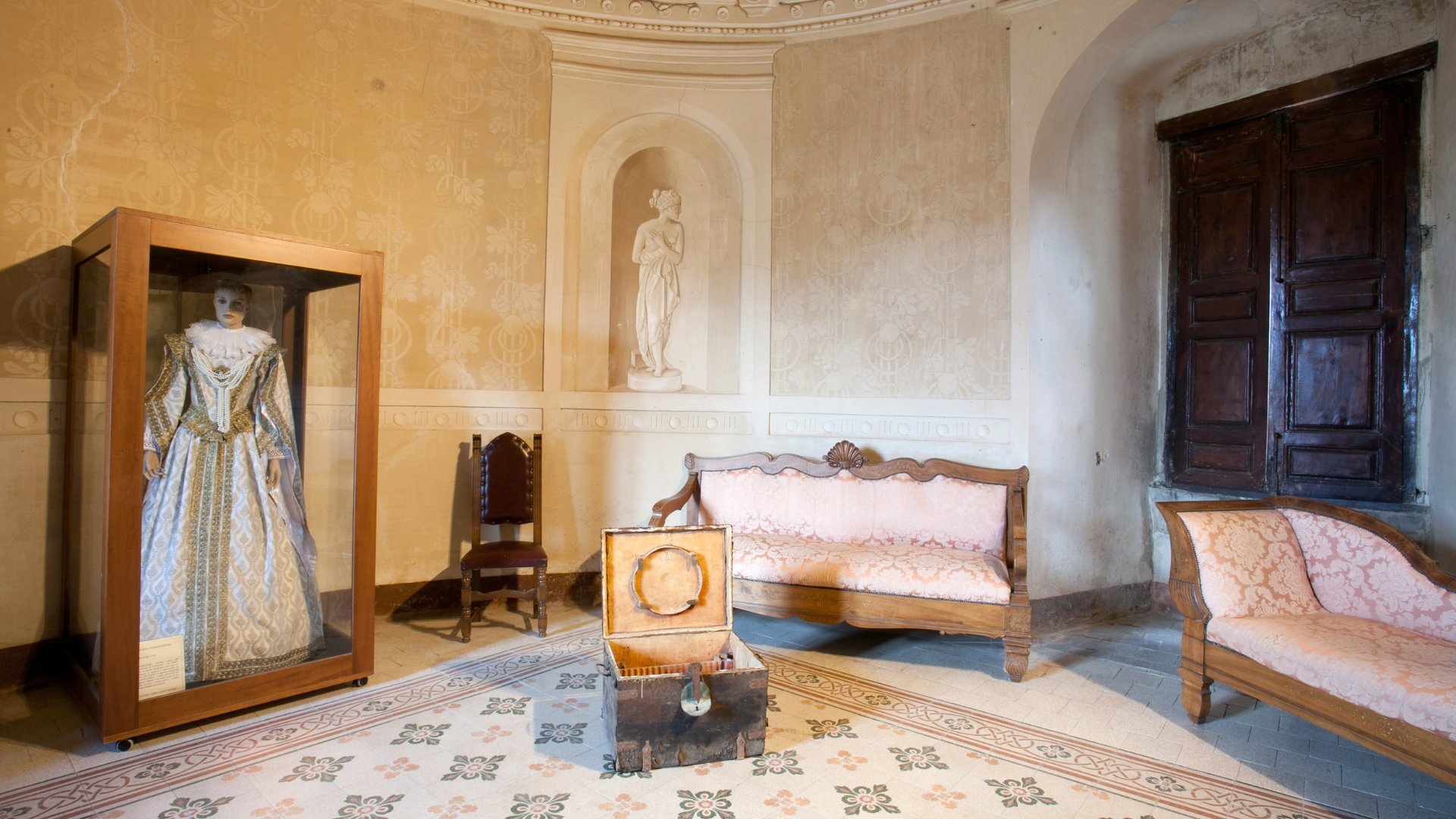
Among the streets of the village, the ancient houses and noble palaces have become the site of other spaces of the diffuse museum. The MUDAM is a true work in progress, which aims to transform the village into a living and propulsive centre of culture and sociality. It includes exhibition and educational areas such as Palazzo Giannettasio (transformed into a house of culture, housing the Museum of Peasant Civilisation, the permanent exhibition dedicated to the photographer Gerarld Rholfs, and the headquarters of the Nuovo Umanesimo foundation) and Palazzo Tarsia-Toscano, home to the interesting library centre. Alongside them, there are realities dedicated to the rebirth of real entrepreneurial activities linked to the artistic sector, such as the Casa delle Arti e delle Idee (House of the Arts and Ideas), where lovers of the reborn lute-making tradition find hospitality, or the atelier of the painter Francesco Diego, located in an old structure made available by the municipality on loan for use. Among the many cultural and artistic gems there is also the archaeological area of the 15th-century Monastery of St. Francis of Assisi, located at the foot of the bastion where the village is situated. To visitors who come here in the summer, Oriolo offers the extraordinary charm of performances at the open-air theatre “La Portella”, set in an evocative natural environment: a unique and unmissable experience in which the charm of culture is combined with that of the rugged beauty of the Ionian lands.
Nocara: the city of Epeus, builder of the Trojan Horse

After having immersed ourselves in the artistic and cultural charms of Oriolo, our journey on the trails of Frederick II resumes through the beautiful countryside of the inland area. In fact, we return back along the SP 147 provincial highway to head towards Nocara, already clearly visible on the horizon at the top of a rise.
Shortly before reaching the village, a tourist sign on the left indicates the direction to the convent of Santa Maria degli Antropici. The structure, now owned by the municipality, is definitely worth a visit, both for the beauty of the place where it is located and for its significance in local tradition and devotion. In the chapel, in fact, is kept the venerated image of the Madonna degli Antropici, found, according to tradition, in a cave above the convent.
After returning to the main road, we soon reach the village of Nocara. It is a small rural village of about 305 inhabitants, whose legendary origin, as with other villages in the Sibaritide region, goes back to Homeric heroes. According to tradition, the town’s founder was none other than Epeus, the builder of the Trojan Horse. To this mythical character, today’s inhabitants have dedicated the small but interesting Museo Epeo (Epeus Museum), housed in the town hall.
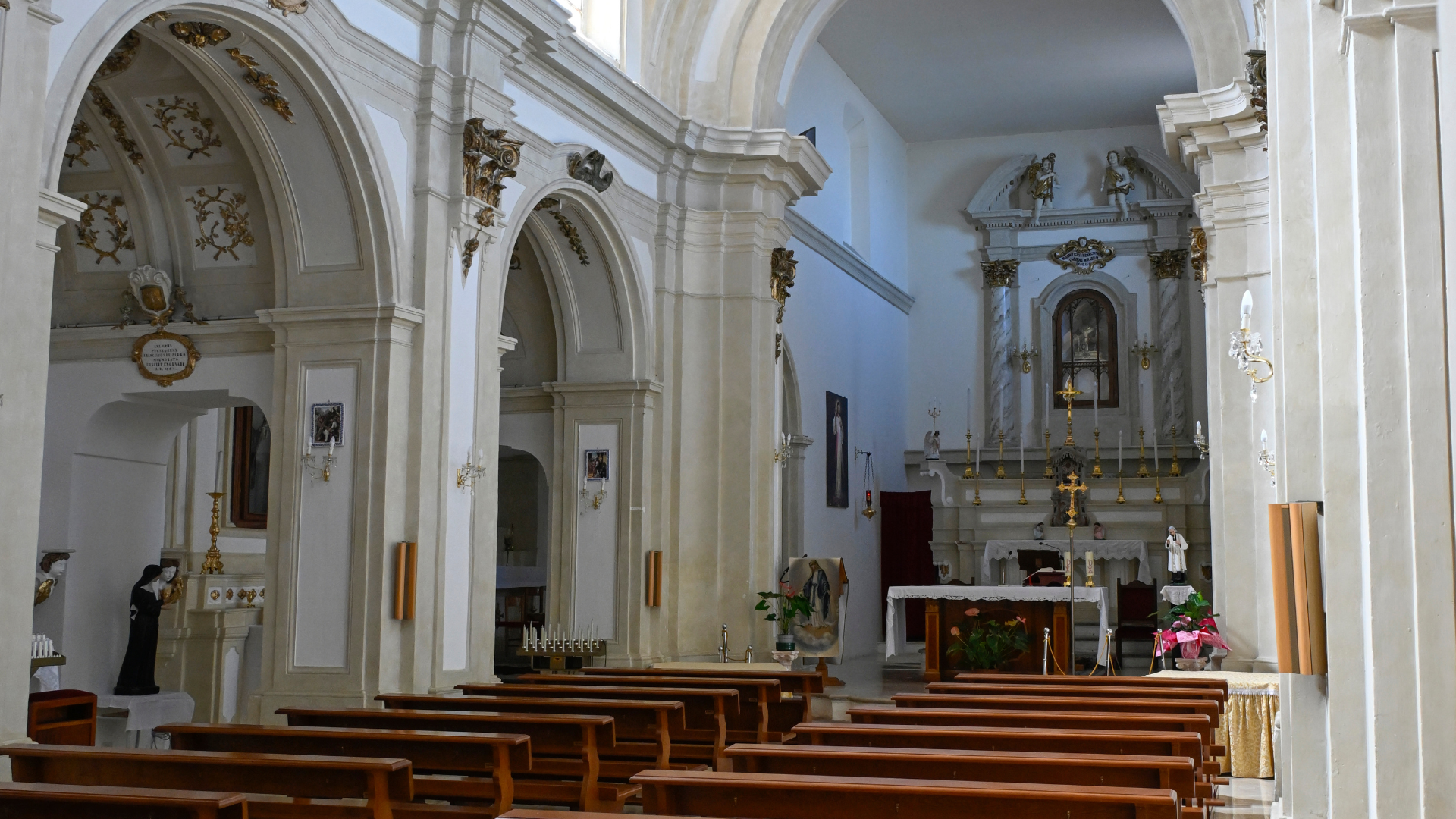
Also worth a visit is the church of Saint Nicholas of Bari, located in the eastern part of the town. Inside the church there are paintings of the Annunciation and the Virgin Mary with Child between Saint Joseph and Saint Nicholas, dating back to the 18th century, the wooden sculpture Ecce Homo from 1550-1590, and a processional silver foil cross from 1630. In the upper part, where the castle once stood, only a square and some traces of walls remain, from where, however, a marvellous panorama can be admired, ranging from the heights of Serra Maiori to the sea.
Returning to the SP 147 provincial highway, at the crossroads, it is possible to take a short detour for about 4 km to visit the archaeological area of Serra Maiori. Along the way there is a small equipped picnic area and, further on, at Armi di Sant’Angelo, a spectacular limestone cliff where many Hellenistic artefacts have been found. At the end of the asphalt road, we continue on foot to the summit of Serra Maiori, where amidst the vegetation are the remains of the ancient city of Presinace, a centre of great importance that once extended its influence from Nocara to Favale and down to the Ionian coast.
Canna: the town of gateways

Not far from Nocara lies the village of Canna. It is a pleasant and hospitable town of about 800 inhabitants, which perfectly preserves its traditions. Today, it presents itself as a village of medieval origins, rich in Renaissance, Baroque and neoclassical elements in the historic centre, with a charming maze of alleyways where you can breathe in the scents of traditional cuisine. Visiting its small historic centre is somehow like taking a leap back in time of almost two hundred years…
Despite its small size, the village of Canna surprises with the presence of numerous nobiliary mansions. Its beautiful panoramic position and proximity to more densely populated centres must have made it a fashionable holiday resort for local notables during the 18th and 19th centuries.
Testifying to these high-class frequentations are the numerous carved stone gateways (there are as many as eleven), often surmounted and flanked by the heraldic coats of arms of noble families, the result of the expert hands of the highly appreciated local stonemasons.

For the tourist, wandering around the streets of the town in search of these little pearls of art can certainly be an opportunity to engage in a curious “treasure hunt” that will lead him/her to the discovery of evocative corners of rare beauty and tranquillity.
During this wandering, visitors cannot fail to find themselves at some point in front of the beautiful façade of the house that once belonged to the Jelpo family and which today, after being acquired by the municipal administration, is home to the Palazzo delle Culture e dell’Ospitalità (Palace of Cultures and Hospitality), an interesting museum centre revolving around the old coal mill, perfectly restored to testify to the local history and traditions linked to the agricultural economy.
Rocca Imperiale, home of the Stupor Mundi

Leaving the small village of Canna, we set off along the SP 150 provincial highway towards the last stop on our long journey to discover the territory of the Sibaritide LAG. The road skirts the spectacular and wild bed of the Canna torrent and leads us to Rocca Imperiale, a gem that enchants visitors with its natural beauty, fascinating history and warm hospitality.
The town is rich in tradition and cultural heritage and offers tourists an unforgettable sightseeing experience, inviting them to discover the secrets of a location that skilfully blends ancient and modern.
Founded by the Greeks in the 7th century B.C., Rocca Imperiale boasts a millenary history that is reflected in its ancient walls and in the winding alleys of the historical centre. The name itself, “Imperiale” (meaning “imperial”), suggests the town’s glorious past under the rule of Frederick II.
One of the most emblematic places in the town is actually the Swabian Castle, dating back to the 13th century, which, according to some testimonies, was one of the favourite headquarters of the great emperor and his court during his travels in his dominions between Sicily and Apulia and for his hunting trips with the falcon, a pastime much loved by Frederick II.
Strategically located on top of a hill, the castle offers a panoramic view of the Ionian Sea and surrounding landscapes. Visitors can explore the ancient walls, towers and interiors, imagining the daily life of the nobles who once inhabited it.
Getting lost in the cobbled alleys of Rocca Imperiale’s historical centre is a journey back in time. The brightly coloured houses and welcoming squares capture the essence of an ancient community that is still alive. Numerous churches testify to the deep spirituality that has permeated the lives of residents over the centuries. The Chiesa Matrice dell’Assunzione della Beata Vergine (Mother Church of the Assumption of the Blessed Virgin), in particular, impresses with its splendid rose window and the fine depiction of Christ on the tympanum above the entrance. The interior, with three naves decorated in Baroque style, houses a number of works of art of considerable value as well as a wooden crucifix with a gold halo and valuable altars.
Also of great historical and artistic interest is the small church of the Madonna della Nova (Our Lady of the Good News), located outside the town, in Le Cesine, in the countryside sloping towards the coast. It is said to have been built around 1400 by a pilgrim prince who, after being shipwrecked on the Ionian coast, spent his life on the hill where the church stands to do penance in gratitude. The chapel houses an oil painting on canvas of the image of Our Lady of the Good News, depicting the visit of the Virgin Mary to her cousin Elizabeth. The sacred image is transported to and kept in veneration in the Mother Church every year until the 2nd of July.

Back in the town centre, we find, in the buildings of an old Franciscan monastery, a museum complex surprisingly rich and varied in the collections on display. Alongside the more famous Wax Museum, which houses depictions of famous figures from history, art and entertainment, there are other permanent exhibitions with different themes, such as the room dedicated to life-size mythological figures such as Polyphemus, the Minotaur and Medusa (Mythological Museum), naturalistic exhibits related to the marine environment (Scientific Museum of the Sea), an exhibition of ancient tools, units of measurement, deeds and rules (Medieval Museum), minerals from all over the world (Mineralogical Museum), a display of ancient recipes and typical products (Soap Museum) and a collection of nativities from the five continents along with religious-themed artefacts (Mixed Museum), as well as the Heraldic Museum.
The cultural liveliness that characterises this area is also evidenced by the many events that take place regularly throughout the year. Among the most important ones, “Il Federiciano” is certainly worth mentioning: an international poetry festival that takes place in the last week of August and, inspired by the great cultural rebirth of which Emperor Frederick himself was the protagonist, brings thousands of poets and verse lovers from all over Italy and abroad to the Calabrian town, offering a rich programme of events, conferences and shows.
We now leave the historical centre of Rocca Imperiale for the last act of our long journey through the territory of the Sibaritide LAG, in a true triumphal march through beauty, amidst the green of the olive trees and the yellow of the lemons, that Frederick’s Gold that represents one of the most typical and appreciated horticultural products of Rocca Imperiale, protected by the PGI (Protected Geographical Indication) mark. Crossing the countryside, we finally reach the marina, once again in front of the blue of the Ionian Sea and its splendid beaches, overlooked by the imposing Torre di Guardia (Watch Tower), a witness to centuries of history and the vicissitudes of the many peoples who, over time, have given life to the extraordinary wealth of culture, art and traditions characterising the Ionic Arc of the Sibaritide region.
All points of interest
Amendolara: land of history and myth

It was built between the 8th and 9th centuries on the ruins of a Longobard stronghold and was restored in 1239 by Frederick II, who extensively changed its original structure. Frederick lived there for a long time during his travels between Sicily and Apulia and it therefore acquired the importance of “domus imperialis”. Moreover, due to its strategic position, it was a major place of assembly and passage for knights, Basilian monks and crusaders embarking for the Holy Land. Like the other castles of the time, it passed into the hands of the Angevins and then the Sanseverino family. What remains of it today is the result of various alterations over the centuries, but one can still admire the beauty of the Aragonese colonnade reminiscent of the splendour of the Magna Graecia, the masonry access bridge, replacing the drawbridge, the moat and the polygonal tower. Inside, a fresco triptych of the Neapolitan school dating back to the end of the 13th century, depicting the crucifixion with Saint John and the Virgin Mary, and another fresco showing the Blessing Almighty enclosed in a mandorla supported by two angels, are of great artistic importance.
Info and contact details:
Municipality of Amendolara –www.comune.amendolara.cs.it

The layout of the exhibition is divided into four sections, arranged according to a chronological logic: protohistory, two sections dedicated to Magna Graecia, and one reserved for Byzantine artefacts. The first section opens with the oldest artefacts in the collection, including earthenware vases, metal tools, weapons and jewellery dating back to the 12th century BC. These artefacts come from an excavation conducted in the city, which uncovered traces of a settlement spanning the late Bronze Age and early Iron Age periods. Also close in terms of dating are the findings from the necropolis of Agliastroso. As far as the ancient Magna Graecia period is concerned, the section presents objects belonging to grave goods, datable between the 8th and 6th century B.C., from the Mancosa-Paladino necropolis. These include Corinthian and Proto-Corinthian ceramic artefacts, bronze materials and other objects, which attest to the Greek colonisation through Sybaris. Other artefacts come from the ancient city found on the San Nicola plateau and in the plain below, where traces of a real city with temples and necropolis have been identified. Among the exhibits are votive statuettes, bronze coins and clay loom weights, some decorated with intricate labyrinths, evidence of the intensive production of woollen textiles. The section devoted to the Byzantine period contains marble architectural fragments and other liturgical furnishings from the town churches of San Giovanni and Annunziata.
Info and contact details:
Laviola Archaeological Museum – Tel 0981 911329
Roseto Capo Spulico: roses and castles…

The castle dates back to the 10th century and is called Petrae Roseti (“of the Roseto Stone”) because, as Saint Vitalis of Castronuovo recalls, it was on the “Roseto Stone” that the saint is said to have founded a monastery. On the ruins of the sacred building, the Castrum Petrae Roseti was built in the 11th century by the Normans. At that time, the castle marked the border between the possessions of Robert Guiscard and his brother Roger II, father of Constance of Altavilla, heir to the Kingdom of Sicily and mother of Frederick II. In the 13th century, it was requisitioned by Frederick II from the Templar Knights in retaliation for their betrayal during the crusade to the Holy Land, and became a purely military fortress; from the Angevin registers, we know the size of the garrison assigned to the fortress, which in 1275 was composed of the castellan, a squire and twelve guards. The castle has a trapezoidal plan and is surrounded by high crenellated walls; on the south side, under a vast entrance, there is an imposing Gothic portal that still displays the crusade rose, lily petals, Solomon’s circle and the coat of arms with the gryphon, the emblem of the Swabian house. The castle is surrounded by mighty watchtowers, one of which is taller, crenellated and with a quadrangular plan. Inside the fortress is a large courtyard with a central tank for water supply and the remains of the stables, while the interior features reception halls and large rooms still furnished in the medieval style. Because of its beauty, state of preservation and position on the sea, the castle is a real pearl of the Alto Ionio Cosentino region.
Info and contact details:
Roseto Castle –www.castellofedericiano.it
Municipality of Roseto Capo Spulico – www.comune.rosetocapospulico.cs.it

It is located in an imposing building dating back to the Norman domination, in the centre of the town, commissioned by Robert Guiscard himself. In its rooms, more than 2,000 artefacts have been saved from oblivion thanks to a patient work of collection. The museum is an authentic monument to historical memory, relived in a journey studded with everyday objects, a journey that uses the stages of human life as a metaphor for history. It starts with toys and a school classroom, complete with desks and blackboard, and arrives at the tools of agricultural and artisan life: the benches used by carpenters, blacksmiths, barbers and finally the loom. Alongside the ancient Roseto, the museum also celebrates some famous contemporary citizens, such as the twice gold medallist at Sydney’s Olympic Games Domenico Fioravanti or the poet and writer Dante Maffia, founder of the magazines “Policord” and “Poetica”.
Info and contact details:
Municipality of Roseto Capo Spulico – www.comune.rosetocapospulico.cs.it
Oriolo, an open-air museum
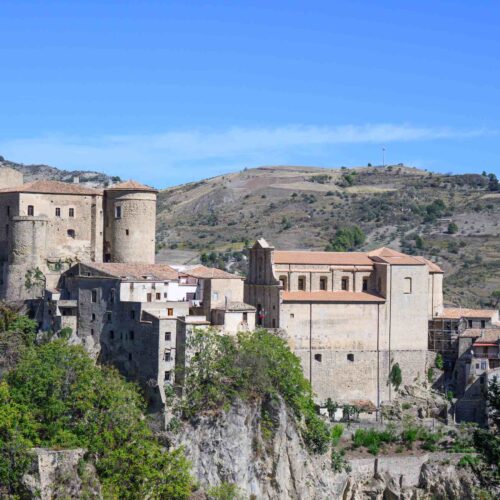
Due to its strategic position, Oriolo acquired the role of control centre in the north of Calabria, hence the castle and imposing walls were built. The castle is of Norman origin with a quadrangular layout. It was owned by the Swabians, Angevins, Aragonese, the Sanseverino princes and the Lopes Vergara family. The door bears the coat of arms of the Pignoni del Caretto noble family, who owned it in the 16th and 17th centuries. Well-preserved, despite its collapse in the 1930s, the Castle is the highlight of the village, a landmark together with the church of San Giorgio Martire (Saint George the Martyr). The structure had been abandoned in the barbarian period and then rebuilt and fortified in Byzantine times as a strategic point dominating the coast, with its circular observation towers. Of the four towers, only three are still standing around the keep and the central body of the building. This is the starting point of the visiting routes proposed by the MUDAM, the Museo Diffuso delle Arti e dei Mestieri (Widespread Museum of Arts and Crafts), which enhances the tangible and intangible cultural assets naturally distributed throughout the territory of the town, a set of elements that chorally narrate the identity and historical value of this area, showing its characteristic and distinctive aspects.
Info and contact details:
Municipality of Oriolo – www.oriolo.eu

The La Portella theatre is located on the slopes of the historic centre of Oriolo, in a wide gorge along the Falce stream that runs alongside the town. The area is bordered by a high rock wall, almost a natural backdrop that wraps around and delimits the entire stage area. On the opposite side, behind the cavea, we find a steep ridge with steps carved into the rock that climb up to the heart of the village. The project to transform this area into an open-air theatre was the brainchild of a citizen of Oriolo, Rocco Abate, who realised that the morphology of the place was already a natural cavea, but imagined its transformation into a much larger and more evocative structure. Shortly afterwards, the municipality of Oriolo, as part of a reclamation and recovery project for the area, put the idea of the theatre to good use, giving birth to “La Portella” in the mid-1990s. In the summer of 1998, the first theatre festival took place. From its very first editions, the festival, which is held regularly during the summer months, stands out for the quality of the performances and the prestige of the people who tread that stage. Over the years, it has featured guests such as: Giorgio Albertazzi, Paola Gassman, Mario Scaccia, Monica Guerritore, Arnoldo Foà, Paolo Rossi, Moni Ovadia and, more recently, Gabriele Lavia, Giuliana De Sio, Ascanio Celestini and Giorgio Panariello. Not to mention refined musicians such as Peppe Servillo and Enzo Gragnaniello, Edoardo Siravo and the Oscar-prize winner Nicola Piovani.
Info and contact details:
Portella theatre of Oriolo – www.portellateatro.it

Not far from the castle stands Oriolo’s mother church, dedicated to Saint George the Martyr, the town’s patron saint, and listed as a national monument by the Ministry of Culture. The current appearance of the church is neoclassical, but the two lions guarding the central door are reminiscent of its original Norman layout. Inside, there are precious works such as the 16th-century depiction of the Virgin Mary with Child, the 18th-century organ, the wooden altar salvaged from the Capuchin convent, and a precious silver reliquary containing the big toe of St Francis of Paola.
Rocca Imperiale, home of the Stupor Mundi

The Castle of Rocca Imperiale dominates the town from the top of a hill a few hundred metres from the sea. It was a strategically crucial defence point. The main entrance is off-centre and much higher than the level of the countryside, with a so-called “left” gate that forced attackers to walk a long stretch uncovered under the walls, opening themselves up to the danger of attacks from above. Observing Frederick’s gate from the embankment, it is possible to see the first crenellation: incorporated in the wall to the right of the gate, it is much lower than those of the tower, and a pair of round windows, typical of Frederick’s period, can be seen in the wall. The present castle moat, the drawbridge and the external structures are certainly subsequent to the Swabian rule. Over time, the manor was owned by the Sanseverino family and then passed to the Pignone family. The castle, which has a quadrangular plan with an inner courtyard, is equipped with supply rooms, water tanks, stables, torture chambers, dungeons, surrounding walls, parapets and observation towers, which were the salvation of the inhabitants during the Turkish invasions of the 16th and 17th centuries, so much so that the castle was never conquered.
Info and contact details:
Rocca Imperiale tourist information – www.roccaimperiale.info

Housed in the premises of the former 16th-century Monastery of the Observant Friars, the Wax Museum of Rocca Imperiale exhibits life-size wax statues of historical figures while also reconstructing a series of fundamental events for the town of Rocca Imperiale and the surrounding area. Inside these rooms we can see personalities ranging from Frederick II of Swabia to De Gasperi, from Mussolini to Che Guevara, from Mother Teresa of Calcutta to Rita Levi Montalcini, from Giuseppe Verdi to Totò. The evocative atmosphere of the sacred building and the realism of the statues ensure an exciting and unforgettable visit.
Info and contact details:
Wax Museum – www.museodellecere.net
Rocca Imperiale tourist information – www.roccaimperiale.info

The lemons of Rocca Imperiale, known under the evocative name of Frederick’s Gold, are one of the most typical products of this area. The position of this territory is ideal for the cultivation of lemons: protected by the hills to the north-west, caressed by the climate mitigated by the sea to the south-east, this region is a real cradle, a habitat that is not affected by excessively cold winters and that also protects the fruit from the attack of fungi and other diseases typical of these plants. Because of their extraordinary quality and historicity, the production of Rocca Imperiale lemons has been awarded the PGI (Protected Geographical Indication) mark. The lemon, however, is only the starting point, the cornerstone of an industry with many faces such as jams, sweets, candied peels or liqueur. Lemon and lime liqueurs are typical of this area, has an intense lemon scent and a yellow-green colour similar to liquid gold. A single sip fills the throat with sweet aromas contrasted by the sourness of the lemon and the strong flavour typical of any alcoholic beverage. The citrus fruit peels are left to macerate for two months in the alcohol, then the process is completed by adding sugar until completely dissolved. Only then, the spirit is filtered and bottled.
Info and contact details:
Rocca Imperiale tourist information – www.roccaimperiale.info

Rocca Imperiale is a Blue Flag municipality, an award obtained as a tourist seaside resort that meets specific criteria related to environmental sustainability. The town also holds another important recognition as it is included in the “Borghi più Belli d’Italia” (Italy’s Most Beautiful Villages) club.
In recent years, the town, first among the municipalities of Calabria, has also been awarded the Lilac Flag, which is not only an acknowledgement for the area, but a concrete commitment to an increasingly inclusive tourism, carried out by organisations, associations and operators in the sector, to break down barriers and create a future where travelling is truly everyone’s right.


